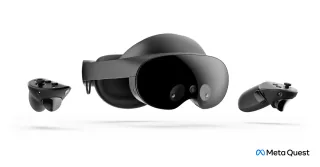
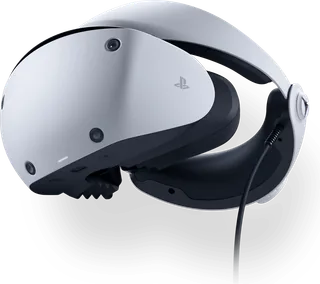
Meta Quest Pro vs Sony PlayStation VR2
Better figure, where one is clearly better
| MetaQuest Pro | SonyPlayStation VR2 | |
|---|---|---|
| Overview | ||
| Released | October 2022 | February 2023 |
| Display | ||
| Resolution per eye | 1800 × 1920 | 2000 × 2040 (better) |
| Panel | LCD | OLED |
| Refresh rate | 90 Hz | 120 Hz (better) |
| Field of view | 106° horizontal | – |
| Display details | Two LCD panels, 1800 × 1920 per eye, with a local-dimming backlight (about 500 zones) and Display P3 colour; 72 and 90 Hz | OLED, 2000 × 2040 per eye; 90 and 120 Hz |
| Lenses | Pancake lenses; 106° horizontal and 96° vertical field of view (Meta's claim, via Road to VR) | Fresnel lenses; field of view approx. 110° (Sony doesn't say horizontal or diagonal); adjustable lens separation with a dial |
| Lens spacing (IPD) | Continuous IPD adjustment, 55–75 mm, and eye-relief adjustment | – |
| Tracking and input | ||
| Eye tracking | Yes | Yes |
| Hand tracking | Yes | No |
| Controllers in the box | Yes | Yes |
| Colour passthrough | Yes | No |
| Sensors | Inside-out; five external and five internal cameras for headset, hand, eye and face tracking | Inside-out; four embedded cameras for headset and controller tracking; one IR eye-tracking camera per eye; six-axis motion sensor; IR proximity sensor |
| Controllers | Touch Pro controllers with their own inside-out tracking cameras, rechargeable, pressure-sensitive thumb rest and stylus tip | Two PS VR2 Sense controllers with adaptive triggers, haptic feedback, finger touch detection and IR LED tracking; 520 mAh built-in battery, 168 g each; Bluetooth 5.1 |
| Passthrough | Full-colour passthrough; the outward cameras capture four times as many pixels as Quest 2's (Meta) | Monochrome See-through View from the tracking cameras, at the touch of a button (Tom's Guide) |
| Performance | ||
| Works | Standalone or with a PC | Needs a PC or console |
| Chip | Snapdragon XR2+ | – |
| Storage | 256 GB | – |
| Chip details | Snapdragon XR2+ | – |
| Memory | 12 GB RAM; 256 GB storage | – |
| Connections | USB-C; PC VR over Meta Quest Link | Single USB-C cable to a PS5; PC via the PlayStation VR2 PC adapter (from 7 August 2024) for SteamVR games. HDR, eye tracking, headset feedback, adaptive triggers and haptic feedback beyond rumble are unavailable on PC. |
| Design | ||
| Battery | Built in | None (powered by a PC or console) |
| Battery life (maker's claim) | Up to 2 hours | – |
| Weight (headset) | 722 g | 560 g (better) |
| Battery details | 1–2 hours; curved battery at the back of the headset | – |
| Audio | Speakers in the headstrap; dual 3.5 mm headphone outputs | Built-in microphone; stereo headphone jack |
| Strap | – | Adjustable headband and scope; approx. 212 × 158 × 278 mm; 560 g excluding cables |
More comparisons
- Apple Vision Pro (M5) vs Meta Quest Pro
- Samsung Galaxy XR vs Sony PlayStation VR2
- Meta Quest 3S vs Meta Quest Pro
- Pimax Crystal Light vs Sony PlayStation VR2
- Apple Vision Pro vs Sony PlayStation VR2
- Meta Quest 3 vs Meta Quest Pro
- Sony PlayStation VR vs Sony PlayStation VR2
- HTC VIVE XR Elite vs Meta Quest Pro
- Meta Quest 2 vs Meta Quest Pro
- Meta Oculus Quest vs Meta Quest Pro