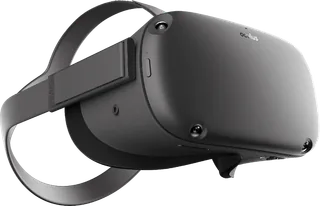
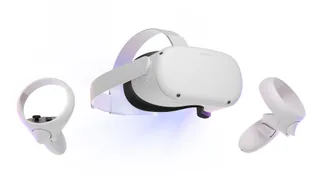
Meta Oculus Quest vs Meta Quest 2
Better figure, where one is clearly better
| MetaOculus Quest | MetaQuest 2 | |
|---|---|---|
| Overview | ||
| Released | May 2019 | October 2020 |
| Display | ||
| Resolution per eye | 1440 × 1600 | 1832 × 1920 (better) |
| Panel | OLED | LCD |
| Refresh rate | 72 Hz | 120 Hz (better) |
| Display details | Dual OLED displays (Road to VR); 1440 × 1600 physical pixels per eye confirmed by Meta's developer table, distinct from its 1216 × 1344 default render resolution. Meta documents 72 Hz for apps and a separate 60 Hz mode for media playback. | LCD, 1832 × 1920 per eye; 72 Hz at launch, 90 Hz and then 120 Hz added by software updates (Meta's developer documentation lists 72, 80, 90 and 120 Hz) |
| Lenses | Fresnel lenses (Road to VR); no manufacturer horizontal field-of-view figure used | Fresnel lenses; field of view the same as the original Quest (Road to VR); Meta doesn't give a figure |
| Lens spacing (IPD) | Physical lens-spacing adjustment, 58–72 mm according to Oculus as reported by Road to VR | Three positions, 58, 63 and 68 mm |
| Tracking and input | ||
| Eye tracking | No | No |
| Hand tracking | Yes | Yes |
| Controllers in the box | Yes | Yes |
| Colour passthrough | No | No |
| Sensors | Oculus Insight inside-out six-degree-of-freedom headset and Touch tracking without external sensors; four cameras (Road to VR). Controller-free hand tracking was added during 2019, rather than available at the May launch; app support is required. No eye tracking. | Inside-out tracking; controller-free hand tracking |
| Controllers | Two Touch controllers with tracking rings; one AA battery each (Road to VR) | Two Touch controllers with tracking rings; one AA battery each, about four times the original Quest controllers' battery life |
| Passthrough | Black-and-white view from the tracking cameras (Wareable) | Passthrough from the tracking cameras, not in full colour (Meta's Quest 3 page contrasts its full-colour passthrough with Quest 2) |
| Performance | ||
| Works | Standalone or with a PC | Standalone or with a PC |
| Chip | Snapdragon 835 | Snapdragon XR2 |
| Storage | 64 GB, 128 GB | 64 GB, 128 GB, 256 GB |
| Chip details | Qualcomm's exact Quest launch announcement confirms Snapdragon 835 Mobile VR Platform | Snapdragon XR2 |
| Memory | – | 6 GB RAM |
| Connections | Standalone at launch; Oculus Link PC VR beta released 18 November 2019, using a compatible gaming PC and high-quality USB 3 cable. USB-C charging connector (Wareable); no storage-expansion slot (Road to VR). | PC VR over a USB-C Link cable or Air Link over Wi-Fi |
| Design | ||
| Battery | Built in | Built in |
| Battery life (maker's claim) | Up to 3 hours | Up to 3 hours |
| Weight (headset) | 571 g | 503 g (better) |
| Battery details | Oculus claims approximately two hours gaming or three hours watching media, as reported by Wareable; rechargeable battery in the headset, charged over USB-C | 2–3 hours, as Oculus told Road to VR at launch |
| Audio | Built-in speakers and two 3.5 mm stereo headphone sockets; either socket accepts a normal stereo headphone plug (Road to VR) | Built-in speakers and a 3.5 mm headphone jack (Road to VR) |
| Strap | Flexible adjustable straps; 571 g headset weight reported by Road to VR, including the built-in battery | Soft strap; Elite Strap and Elite Battery Strap sold separately |
| In the box | Headset, two Touch controllers, glasses spacer and USB-C charging cable; spacer and cable documented by Wareable | – |
More comparisons
- Meta Quest 2 vs Valve Steam Frame
- Meta Oculus Quest vs Valve Steam Frame
- Meta Quest 2 vs Meta Quest 3S
- Meta Oculus Quest vs Meta Quest 3S
- Meta Oculus Quest vs Meta Quest 3
- Meta Quest 2 vs Meta Quest 3
- HTC VIVE XR Elite vs Meta Quest 2
- HTC VIVE XR Elite vs Meta Oculus Quest
- Meta Quest 2 vs Meta Quest Pro
- Meta Oculus Quest vs Meta Quest Pro
- Meta Oculus Quest vs Meta Oculus Rift S