Nintendo DS Lite vs Nintendo Game Boy Micro
Better figure, where one is clearly better
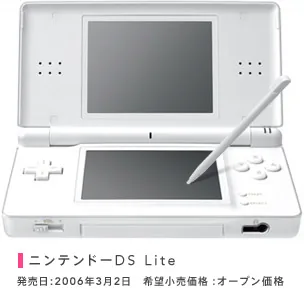
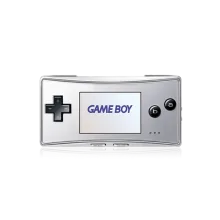
| NintendoDS Lite | NintendoGame Boy Micro | |
|---|---|---|
| Overview | ||
| Released | March 2006 | November 2005 |
| Performance | ||
| Type | Handheld | Handheld |
| CPU | ARM9 CPU and ARM7 CPU | 32-bit RISC CPU and 8-bit CISC CPU |
| Disc drive | No | No |
| CPU | – | 32-bit RISC CPU plus 8-bit CISC CPU (Nintendo) |
| Storage detail | Games on Nintendo DS cards or Game Boy Advance cartridges; no built-in game storage | Game Boy Advance Game Paks; saves on the cartridge |
| Storage expansion | Game Boy Advance cartridge slot | – |
| Display and video | ||
| Built-in screen | 3″ LCD, 256 × 192 | 2″ LCD, 240 × 160, 60 Hz |
| Built-in screen | Two 3-inch backlit TFT LCDs, 256 × 192 each, approximately 260,000 colours; four brightness levels and a resistive touch screen on the lower display (Nintendo Japan) | Two-inch back-lit LCD with 240 × 160 pixels, 60 Hz and four brightness settings (Nintendo UK) |
| Audio | Built-in stereo speakers and microphone; virtual surround in supported games; stereo headphone and microphone connector | Built-in speaker and standard headphone socket |
| Design and power | ||
| Battery life (maker's claim) | Up to 19 hours | Up to 10 hours |
| Weight | 218 g | 80 g (better) |
| Battery life detail | Built-in rechargeable lithium-ion battery; approximately 15–19 hours at lowest brightness, 10–15 at low, 7–11 at high and 5–8 at highest, varying by software; full charge approximately 3 hours (Nintendo Japan) | Rechargeable lithium-ion battery; Nintendo quotes approximately 6–10 hours of play and 2.5 hours to charge |
| Size | 133 × 73.9 × 21.5 mm when folded (width × depth × thickness) | 101 × 50 × 17.2 mm (width × height × depth) |
| Colours | Crystal White, Ice Blue, Enamel Navy, Noble Pink, Jet Black, Gloss Silver, Metallic Rose and Crimson/Black (Nintendo Japan's series page; regional ranges vary) | Silver, green, blue and pink at the UK launch, with interchangeable faceplates |
| Connections | ||
| Ports | Nintendo DS card slot, Game Boy Advance cartridge slot and stereo headphone/microphone connector | Game Pak slot, headphone socket, charging connector and Micro-specific link connector; Game Boy Advance links need an adapter |
| Wi-Fi and Bluetooth | IEEE 802.11 and Nintendo's own wireless protocol; nominal range 10–30 m depending on surroundings; supported games allow several consoles to share one DS card | – |
| Controller | Built-in D-pad, A/B/X/Y, L/R, Start and Select buttons; touch screen and stylus; built-in microphone with voice recognition in supported games | Built-in D-pad, A, B, L, R, Start and Select buttons; interchangeable faceplate |
| Backward compatibility | Nintendo DS and Game Boy Advance games; no Game Boy or Game Boy Color cartridges. Game Boy Advance communication functions, link cable, Wireless Adapter, e-Reader+ and GameCube–GBA cable are unsupported | Game Boy Advance games only; no original Game Boy or Game Boy Color Game Paks |
More comparisons
- Nintendo Game Boy Micro vs Nintendo Switch 2
- Nintendo DS Lite vs Nintendo Switch 2
- Nintendo DS Lite vs Nintendo Switch Lite
- Nintendo DS Lite vs Nintendo New 3DS XL
- Nintendo 3DS XL vs Nintendo DS Lite
- Nintendo 3DS vs Nintendo DS Lite
- Nintendo DS Lite vs Nintendo DSi XL
- Nintendo DS Lite vs Sony PSPgo
- Nintendo DS Lite vs Nintendo DSi
- Nintendo DS Lite vs Sony PSP-3000
- Nintendo DS Lite vs Sony PSP-2000
- Nintendo DS vs Nintendo DS Lite
- Nintendo DS Lite vs Nintendo Game Boy Advance
- Nintendo DS Lite vs Nintendo Game Boy Advance SP
- Nintendo DS Lite vs Sony PSP
- Nintendo DS Lite vs Nintendo Game Boy Color