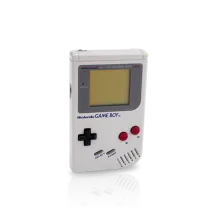
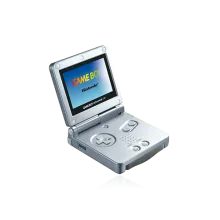
Nintendo Game Boy vs Nintendo Game Boy Advance SP
Better figure, where one is clearly better
| NintendoGame Boy | NintendoGame Boy Advance SP | |
|---|---|---|
| Overview | ||
| Released | September 1990 | March 2003 |
| Performance | ||
| Type | Handheld | Handheld |
| CPU | Sharp SM83 (8-bit), 4.19 MHz | 32-bit ARM with embedded memory |
| GPU | Nintendo DMG-CPU (built-in picture processing) | – |
| Memory | 16 KB | 384 KB (better) |
| Disc drive | No | No |
| CPU | Sharp SM83 (8-bit) at 4.194304 MHz in the Nintendo DMG-CPU (mGBA documentation) | 32-bit ARM with embedded memory (Nintendo) |
| GPU | Picture processing built into the DMG-CPU; 40 sprites, up to 10 per line (mGBA documentation) | – |
| Memory detail | 8 KB work RAM and 8 KB video RAM; compatible cartridges can add up to 128 KB RAM (Nintendo programming manual) | 32 KB internal memory, 96 KB video RAM and 256 KB external work RAM (Nintendo) |
| Storage detail | Game Boy Game Paks (cartridges); saves on the cartridge | Game Boy Advance, Game Boy Color and Game Boy Game Paks; saves on the cartridge |
| Display and video | ||
| Built-in screen | 2.5″ LCD, 160 × 144 | 2.9″ LCD, 240 × 160 |
| Built-in screen | 2.5-inch monochrome LCD, no backlight; 160 × 144; four shades; about 59.7 Hz (Nintendo and mGBA documentation) | 2.9-inch reflective TFT LCD with switchable front light; 240 × 160 pixels and 32,768 possible colours (Nintendo's original model) |
| Audio | Four channels (2 pulse wave, 1 wave, 1 noise); mono speaker and stereo headphone jack (Nintendo and mGBA documentation) | Mono built-in speaker; stereo headphones require an adapter for the EXT 2 connector |
| Design and power | ||
| Battery life (maker's claim) | Up to 30 hours | Up to 10 hours |
| Weight | 220 g | 143 g (better) |
| Battery life detail | 4 × AA batteries, up to 30 hours (Nintendo) | Rechargeable lithium-ion battery; up to 10 hours with the screen light on or 18 hours with it off, with about 3 hours to recharge (Nintendo) |
| Size | – | 82 × 84.6 × 24.3 mm (width × height × depth), closed |
| Colours | – | Silver, blue and pink among the European finishes; special editions also sold |
| Power use | About 0.7 W from the external 6 V DC input (Nintendo US manual) | – |
| Connections | ||
| Ports | Game Link Cable port, Game Pak slot, headphone jack, 6 V DC input (Nintendo) | Game Pak slot, EXT 1 link connector and EXT 2 power/headphone-adapter connector |
| Controller | Built-in D-pad, A, B, Start and Select buttons; volume and contrast dials | Built-in D-pad, A, B, L, R, Start and Select buttons, plus a screen-light switch |
| Backward compatibility | – | Game Boy Advance games and almost all Game Boy and Game Boy Color games; some older cartridges may have display or sound issues |
More comparisons
- Nintendo DS Lite vs Nintendo Game Boy Advance SP
- Nintendo Game Boy Advance SP vs Nintendo Game Boy Micro
- Nintendo Game Boy Advance vs Nintendo Game Boy Advance SP
- Nintendo Game Boy vs Nintendo Game Boy Color
- Nintendo Game Boy vs SEGA Mega Drive
- Nintendo Game Boy vs SEGA Master System
- Nintendo Game Boy vs Nintendo Entertainment System (NES)