OM SYSTEM PEN vs Panasonic LUMIX G97
Better figure, where one is clearly better
| OM SYSTEMPEN | PanasonicLUMIX G97 | |
|---|---|---|
| Overview | ||
| Released | Coming late October 2026 (Japan and North America) | February 2025 |
| Image and sensor | ||
| Camera type | Mirrorless | Mirrorless |
| Sensor format | Four Thirds | Four Thirds |
| Sensor type | Live MOS | CMOS |
| Sensor dimensions | 17.4 × 13 mm | – |
| Effective resolution | 20.4 MP | 20.3 MP |
| Largest image | 5184 × 3888 | 5184 × 3888 |
| RAW recording | Yes | Yes |
| Standard ISO range | 200–25600 | 200–25600 |
| Sensor detail | Approximately 20.37 effective and 21.77 total megapixels; 17.4×13 mm in maker Japan table. Ordinary output 5184×3888; not a stacked sensor | Maker specifies four-thirds CMOS, approximately 20.3 million effective and 21.8 million total pixels; native 4:3 stills 5184×3888. Sensor dimensions and BSI construction are not inferred from other Lumix bodies |
| Image formats | JPEG and 12-bit losslessly compressed ORF RAW; handheld composite 50 MP, tripod composite up to 80 MP RAW developed with OM Workspace, not single-shot sensor resolution | JPEG, RAW and RAW+JPEG; 4K Photo frames are separate cropped JPEG captures |
| ISO detail | ISO 200–25600 with expanded LOW approximately 64 and 100; default Auto upper limit 6400 | Standard stills ISO 200–25600; expanded ISO 100. Creative Video ISO 200–6400 with expanded 100, under the manual's mode restrictions |
| Image processor | TruePic IX | Venus Engine (maker announcement) |
| Lens and shooting | ||
| Lens mount | Micro Four Thirds | Micro Four Thirds |
| Stabilisation | Sensor shift | Lens and sensor shift |
| Maximum continuous burst | 30 fps | 9 fps |
| Autofocus | Sensor phase/contrast detection with 121 cross-type phase positions; human, cat and dog recognition for stills, face/eye detection for video; Starry Sky AF | Contrast-detection TTL AF; AFS/AFF/AFC/MF, face/eye detection, tracking, 49-area, Custom Multi, single-area and pinpoint modes |
| Shutter | Mechanical 1/4000–60 seconds; electronic 1/32000–60 seconds; Bulb, Live Time and Live Composite modes | Mechanical 60–1/4000 second; electronic first curtain 60–1/2000; electronic 1–1/16000. Mechanical/first-curtain Bulb approximately 30 minutes maximum |
| Burst detail | Electronic high approximately 30 fps with fixed focus/exposure, low approximately 8 fps with tracking; mechanical approximately 5 fps. Maker examples at electronic 30 fps give 20 RAW/20 JPEG frames, tracking 8 fps 23 RAW/48 JPEG, with specified SanDisk card and 12–40mm F2.8 PRO II | Full-resolution 9 fps AFS/MF or 6 fps AFF/AFC with mechanical, electronic first-curtain or electronic shutter; 27 or more RAW frames, 600 or more without RAW under specified Panasonic tests and media conditions. 30 fps 4K Photo is approximately 8 MP cropped output and is excluded from native-resolution burst speed |
| Stabilisation detail | Five-axis sensor shift; CIPA 2024 up to 5.5 stops at centre and 4.5 at edges with 14–42mm F3.5–5.6 III at 42mm | Five-axis sensor-shift IBIS and compatible-lens Dual I.S.2, both rated five stops under CIPA yaw/pitch conditions; IBIS tested with H-FS12060 at 60 mm, Dual I.S.2 with H-FSA14140 at 140 mm |
| Flash | – | Built-in pop-up TTL flash, GN 9 at ISO 200 or GN 6.4 at ISO 100; sync up to 1/200 second |
| Exposure controls | PASM, Live ND2–16, focus stacking, HDR and multiple exposure; restrictions depend on shooting mode and lens | – |
| Video | ||
| Highest video resolution | 4096 × 2160 at 24 fps | 3840 × 2160 at 30 fps |
| Video detail | Internal H.264 MOV C4K 4096×2160 at 24p or UHD 3840×2160 at 30/25/24p; 8-bit recording (both reviews). OM-Log400 and OM-Cinema1/2 profiles; separate FHD S&Q up to 120 fps, with crop, no sound and no continuous AF (CameraLabs) | Internal MP4 H.264 3840×2160 at 30/25/24p for European DC-G97E, 100 Mbps; Full HD up to 60p. 4K narrows the angle of view and uses reduced autofocus speed. Maker states no fixed recording time limit but warns that high ambient temperature can stop recording; media/battery also limit duration. V-Log L with maker claim of 12 stops; Internal 4:2:0 8-bit capture (maker advanced manual). No external 10-bit claim adopted from the review without maker confirmation |
| Audio | Built-in stereo microphones; external 3.5 mm microphone socket; 48 kHz/16-bit or 96 kHz/24-bit audio | Stereo audio with AAC compression; 3.5 mm stereo microphone input and headphone output |
| Screen and viewfinder | ||
| Viewfinder | Electronic | Electronic |
| Screen size | 3″ | 3″ |
| Screen dots | 1,040,000 | 1,840,000 |
| Touchscreen | Yes | Yes |
| Tilting screen | Yes | Yes |
| Display detail | Fully articulated 3-inch approximately 1.04-million-dot touchscreen; touchscreen menu operation | Three-inch 3:2 capacitive touchscreen, approximately 1.84 million dots; free-angle articulation (Amateur Photographer) |
| Viewfinder detail | OLED approximately 2.36 million dots and 100% coverage; 1.10–1.23× magnification with 50mm lens at infinity, depending on finder style | 0.39-inch 4:3 OLED, approximately 2.36 million dots, approximately 100% coverage; 1.48× magnification, 0.74× in 35 mm terms under maker's 50 mm/infinity/−1 dioptre/4:3 conditions |
| Connections and design | ||
| Wi-Fi | Yes | Yes |
| Bluetooth | Yes | Yes |
| Battery life (maker's claim) | 410 photographs | 300 photographs |
| Body weight | 344 g (better) | 478 g |
| Release detail | Maker announcement 9 September 2026; Japan and North America scheduled for late October 2026. UK product page has an active preorder state on 2 October; first UK sale date unconfirmed | Maker German announcement confirms February 2025 availability. The UK article, dated December 2024, prints February 2024 for both new cameras; that conflicting year is not used as the release date. No precise first retail day confirmed |
| Recording media | One SD/SDHC/SDXC slot; UHS-I | One SD/SDHC/SDXC slot; UHS-I/UHS-II U3 supported under maker's format and recording restrictions |
| Ports | USB 2.0 Hi-Speed Type-C, micro-HDMI Type D, 3.5 mm microphone socket and hot shoe; USB-C is not a USB 3 transfer-speed claim | USB-C USB 2.0 High Speed; micro HDMI Type D, 2.5 mm remote and 3.5 mm microphone/headphone sockets |
| Wireless connections | Wi-Fi b/g/n and Bluetooth Low Energy 5.2; smartphone GPS tagging rather than built-in GPS | Wi-Fi 802.11b/g/n at 2.4 GHz and Bluetooth Low Energy 5.0; North American channels 1–11 are not assumed identical in every region |
| Battery life detail | BLS-7; approximately 410 CIPA shots using EVF or LCD; approximately 80 minutes CIPA video or 130 minutes with zoom and other operations disabled | DMW-BLC12 lithium-ion, 7.2 V 1200 mAh in the North American specification. CIPA approximately 280 monitor shots or 300 viewfinder shots with H-FS12060 and Nextorage SDXC; approximately 1050 only in Panasonic's specified one-second power-save EVF test |
| Charging | In-camera USB charging with camera off; no USB Power Delivery (maker Japan) | USB-C in-camera charging; USB cable and AC adapter are commercially available rather than assumed supplied |
| Dimensions | Approximately 125.8×74.5×43.3 mm excluding protrusions (maker Japan) | Approximately 130.4 × 93.5 × 77.4 mm, excluding protrusions |
| Weight detail | 344 g body only or 393 g including battery and card (maker Japan); pictured kit lens excluded. CameraLabs pre-production dimensions and loaded weight differ | Maker 478 g body only, 530 g with battery and card; lens excluded |
| Materials | Dust-resistant and IPX1 splash resistance with an OM SYSTEM splashproof lens; not an immersion rating. Operating temperature 0–40°C | Dust/splash-resistant construction; not waterproof. Maker operating range 0–40 °C |
| In the box | – | Body, battery pack, shoulder strap, body cap, hot-shoe cover and battery-grip connector cover; kit includes its lens and lens accessories. Regional contents may vary |
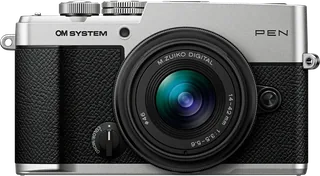
| Colours | Black and silver | – |

More comparisons
- Olympus PEN-F vs OM SYSTEM PEN
- Olympus PEN E-P1 vs OM SYSTEM PEN
- Olympus PEN E-P7 vs OM SYSTEM PEN
- OM SYSTEM OM-5 Mark II vs OM SYSTEM PEN
- Fujifilm X-T30 III vs OM SYSTEM PEN
- OM SYSTEM OM-3 ASTRO vs OM SYSTEM PEN
- OM SYSTEM OM-3 vs OM SYSTEM PEN
- OM SYSTEM OM-3 ASTRO vs Panasonic LUMIX G97
- OM SYSTEM OM-5 Mark II vs Panasonic LUMIX G97
- Panasonic LUMIX G100 vs Panasonic LUMIX G97
- Panasonic LUMIX G9II vs Panasonic LUMIX G97
- Panasonic LUMIX G97 vs Panasonic LUMIX GH7
- OM SYSTEM OM-3 vs Panasonic LUMIX G97
- OM SYSTEM OM-1 Mark II vs Panasonic LUMIX G97
- Panasonic LUMIX G97 vs Panasonic LUMIX GH6
- Panasonic LUMIX G97 vs Panasonic LUMIX GH5 II