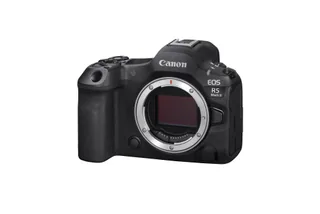
Canon EOS R5 Mark II vs Panasonic LUMIX S5D
Better figure, where one is clearly better
| CanonEOS R5 Mark II | PanasonicLUMIX S5D | |
|---|---|---|
| Overview | ||
| Released | August 2024 | October 2024 |
| Image and sensor | ||
| Camera type | Mirrorless | Mirrorless |
| Sensor format | Full frame | Full frame |
| Sensor type | Back-illuminated stacked CMOS | CMOS |
| Sensor dimensions | 36 × 24 mm | 35.6 × 23.8 mm |
| Effective resolution | 45 MP | 24.2 MP |
| Largest image | 8192 × 5464 | 6000 × 4000 |
| RAW recording | Yes | Yes |
| Standard ISO range | 100–51200 | 100–51200 |
| Sensor detail | Full-frame back-illuminated stacked CMOS; 45 million effective and approximately 50.3 million total pixels; fixed low-pass filter and integrated cleaning | 24.20 million effective pixels and 25.28 million total; anti-reflection coating and sensor-shift dust reduction. Multi-shot high-resolution mode produces 48 or 96 MP files, separately from native single-exposure resolution |
| Image formats | 14-bit RAW/C-RAW, JPEG and 10-bit HEIF; neural-network upscaling to 179 MP is processed output, not native sensor resolution; Dual Pixel RAW requires firmware 1.3.0 or later | JPEG, RAW and HLG Photo; sRGB and Adobe RGB |
| ISO detail | Normal still-photo ISO 100–51200, expandable to 50–102400; movie range depends on colour profile | Standard ISO 100–51200; expanded ISO 50, 102400 and 204800. Dual Native ISO 100/640 in Normal, 640/4000 in V-Log, 400/2500 in HLG and 200/1250 in Cinelike D2/V2 |
| Image processor | DIGIC X and DIGIC Accelerator | – |
| Lens and shooting | ||
| Lens mount | Canon RF | L-Mount |
| Stabilisation | Sensor shift | Lens and sensor shift |
| Maximum continuous burst | 30 fps | 7 fps |
| Lens detail | RF and RF-S directly; EF/EF-S with EF-EOS R adapters; EF-M incompatible; RF-S/EF-S use approximately 1.6× crop | Interchangeable L-Mount body; listed kit lenses are separate optical configurations, not built-in lens specifications |
| Autofocus | Dual Pixel Intelligent AF; 1053 automatic areas, 5850 still-photo or 4500 movie selectable positions; eye-control selection, people/animal/vehicle recognition and registered-person priority; Action Priority has sport and firmware restrictions | Contrast autofocus with DFD; face, eye, body and animal recognition, tracking and 225-area selection. Maker rates detection EV −6 to 20 with F1.4, ISO 100 and AFS. Optional DJI LiDAR Range Finder and RS 3 Pro send ranging information by USB to drive lens focus without a separate focus motor; these accessories are not included |
| Shutter | Mechanical/electronic first curtain 30–1/8000 second; electronic 30–1/32000 second; Bulb available; range depends on mode | Mechanical 1/8000–60 seconds or bulb up to 30 minutes; electronic front curtain 1/2000–60 seconds; electronic 1/8000–60 seconds, with separate bulb restrictions |
| Burst detail | Up to 30 fps electronic or 12 fps mechanical/first curtain; electronic buffer approximately 200 JPEG or 93/86 RAW with CFexpress/SD respectively; pre-continuous shooting saves up to 15 preceding frames; lens, power, card and settings affect rates | Native 7 fps with AFS/MF or 5 fps with AFC, for mechanical, electronic front curtain and electronic shutters. Maker buffer more than 24 RAW/RAW+JPEG or more than 999 JPEG with specified UHS-II U3 card in slot 1. Reduced-resolution 6K Photo 30 fps and 4K Photo 60/30 fps are video-derived JPEG modes, not native full-resolution bursts |
| Stabilisation detail | Five-axis sensor-shift IBIS coordinated with compatible lenses; up to 8.5 stops centre and 7.5 periphery under CIPA 2024 yaw/pitch/roll testing with RF 24-105mm F2.8L IS USM Z at 105 mm; Movie Digital IS is separate | Five-axis sensor-shift Body I.S., maker 5-stop CIPA yaw/pitch rating with S-R2060 at 60 mm; Dual I.S. 2 combines compatible lens O.I.S. for 6.5 stops with S-E70200 at 200 mm |
| Exposure controls | – | 1728-zone multi-pattern metering; multiple, centre-weighted, spot and highlight-weighted modes. Still exposure compensation ±5 EV, video ±3 EV |
| Flash | External Speedlite support; full-frame sync 1/200 second mechanical, 1/250 first curtain or 1/160 electronic; crop-mode sync rates differ | – |
| Video | ||
| Highest video resolution | 8192 × 4320 at 59.94 fps | 4096 × 2160 at 59.94 fps |
| Video detail | 17:9 Light RAW 8192 × 4320 up to 59.94/50 fps; standard RAW and compressed 8K up to 29.97 fps; DCI/UHD 4K up to 119.9/100 fps and Full HD up to 239.8/200 fps; Canon Log 2/3, proxy recording and 10-bit 4:2:2 options; optional CF-R20EP cooling grip required for maker's extended recording claim, not an included fan | Internal C4K 4096×2160 at 59.94p uses APS-C or pixel-by-pixel crop and 4:2:0 8-bit LongGOP; full-frame C4K 29.97p supports 4:2:2 10-bit. UHD 3840×2160 at 59.94p supports cropped 4:2:0 10-bit. Maker limits internal 10-bit C4K/4K recording to 30 minutes, while specified 4K 8-bit modes have no fixed time limit subject to power, storage and operating conditions. External 12-bit HDMI RAW up to 5888×3312 at 29.97p requires compatible Atomos or Blackmagic recorder; this is not internal 5.9K recording. V-Log/V-Gamut and maker 14+ stop claim |
| Audio | Internal stereo microphone; microphone input and headphone output; four-channel 24-bit recording with compatible settings/accessories | Built-in stereo microphone; 3.5 mm microphone/line input and headphone output. Optional DMW-XLR1 provides XLR input; internal MOV LPCM two-channel 48 kHz/16-bit audio |
| Screen and viewfinder | ||
| Viewfinder | Electronic | Electronic |
| Screen size | 3.2″ | 3″ |
| Screen dots | 2,100,000 | 1,840,000 |
| Touchscreen | Yes | Yes |
| Tilting screen | Yes | Yes |
| Display detail | Fully articulating 3.2-inch capacitive touchscreen with anti-smudge coating; top status panel | Free-angle three-inch 3:2 TFT LCD, approximately 1.84 million dots and capacitive touch controls |
| Viewfinder detail | 0.5-inch OLED, approximately 5.76 million dots, 100% coverage and 0.76× magnification; refresh up to approximately 120 fps | OLED approximately 2.36 million dots, 100% coverage and 0.74× magnification with 50 mm lens at infinity, −1 dioptre and 3:2 ratio; 60/120 fps display |
| Connections and design | ||
| Wi-Fi | Yes | Yes |
| Bluetooth | Yes | Yes |
| Battery life (maker's claim) | 340 photographs | 450 photographs |
| Body weight | 656 g | 630 g (better) |
| Release detail | Canon Camera Museum confirms marketed August 2024; maker announcement promised August availability; no retail day inferred | Maker European announcement confirms availability from the end of October 2024; month precision retained without an inferred UK retail day. S5D supplemental instructions explicitly refer to the supplied S5 operating manual for shared specifications. Exact S5D manufacturer specification sheet is available from a UK retailer; regional product tables refused scripted access. No inferred replacement link across co-sold S5 models |
| Recording media | One CFexpress Type B slot supporting CFexpress 2.0/VPG400 and capacity up to 2 TB; one UHS-II SD/SDHC/SDXC slot | Two SD/SDHC/SDXC slots; slot 1 supports UHS-I/UHS-II including V90, slot 2 UHS-I |
| Ports | USB-C 3.2 Gen 2, full-size HDMI Type A, microphone/headphone sockets, N3 remote and PC sync; multi-function shoe; Ethernet requires optional BG-R20EP or CF-R20EP | USB-C 10 Gbps, micro-HDMI Type D, 2.5 mm remote and 3.5 mm microphone/headphone sockets |
| Wireless connections | UK maker specifies Wi-Fi 802.11ax 2×2 MIMO at 2.4/5/6 GHz with regional restrictions and Bluetooth 5.3; Asian page excludes 6 GHz, so regional capability differs | Wi-Fi 2.4 GHz IEEE 802.11b/g/n and 5 GHz IEEE 802.11a/n/ac; Bluetooth Low Energy 4.2. The S5D supplemental manual removes Wi-Fi PC transfer and LUMIX CLUB/web-service/cloud-sync functions present in the original S5 instructions |
| Battery life detail | LP-E6P; maker claim at 23°C approximately 340 photographs with EVF or 630 with LCD; older LP-E6NH/LP-E6N restrict functions | DMW-BLK22, 7.2 V 2200 mAh 16 Wh. Maker CIPA 430 LCD/450 EVF shots with S-R1840 or 410 LCD/430 EVF with S-R28200; headline uses the highest standard EVF claim, not power-save mode. Conditional one-second power-save EVF figures 1500/1450 respectively |
| Charging | USB PD-E1/PD-E2; DR-E6P DC coupler requires PD-E2 | In-camera USB charging and power supply; supplemental S5D manual identifies battery charger, AC adapter and USB cable as optional |
| Dimensions | Approximately 138.5 × 101.2 × 93.5 mm (width × height × depth) | Approximately 132.6 × 97.1 × 81.9 mm, excluding protrusions |
| Weight detail | Approximately 656 g body only; 746 g including battery and card | Approximately 630 g body with hot-shoe cover, excluding body cap; 714 g with battery and one SD card. Kit lens excluded |
| Materials | Magnesium-alloy body/chassis with glass-fibre polycarbonate components; dust- and water-resistant construction is not waterproof | Magnesium-alloy full die-cast body; dust/splash-resistant construction, not waterproof; operating range 0–40 °C |
| In the box | – | Body cap, hot-shoe cover, battery-grip connector cover, shoulder strap and battery; kit includes its lens and lens caps, with lens hood additionally listed for DC-S5DH |

More comparisons
- Canon EOS R5 Mark II vs Canon EOS R8 Mark II
- Canon EOS R5 Mark II vs Sony Alpha 7R VI
- Canon EOS R5 Mark II vs Canon EOS R6 V
- Canon EOS R5 Mark II vs Canon EOS R6 Mark III
- Panasonic LUMIX S1II vs Panasonic LUMIX S5D
- Panasonic LUMIX S1IIE vs Panasonic LUMIX S5D
- Canon EOS R5 Mark II vs Canon EOS R50 V
- Canon EOS R5 Mark II vs Panasonic LUMIX S1RII
- Panasonic LUMIX S1RII vs Panasonic LUMIX S5D
- Canon EOS R5 Mark II vs Sony Alpha 1 II
- Canon EOS R1 vs Canon EOS R5 Mark II
- Canon EOS R1 vs Panasonic LUMIX S5D
- Panasonic LUMIX S5 vs Panasonic LUMIX S5D
- Canon EOS R8 vs Panasonic LUMIX S5D
- Nikon Z6III vs Panasonic LUMIX S5D
- Panasonic LUMIX S5D vs Panasonic LUMIX S9