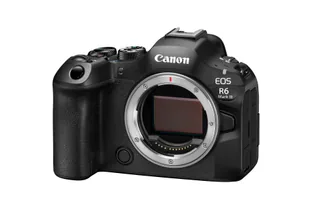
Canon EOS R6 Mark II vs Canon EOS R6 Mark III
Better figure, where one is clearly better
| CanonEOS R6 Mark II | CanonEOS R6 Mark III | |
|---|---|---|
| Overview | ||
| Released | November 2022 | November 2025 |
| Image and sensor | ||
| Camera type | Mirrorless | Mirrorless |
| Sensor format | Full frame | Full frame |
| Sensor type | CMOS | CMOS |
| Sensor dimensions | 35.9 × 23.9 mm | 35.9 × 23.9 mm |
| Effective resolution | 24.2 MP | 32.5 MP |
| Largest image | 6000 × 4000 | 6960 × 4640 |
| RAW recording | Yes | Yes |
| Standard ISO range | 100–102400 | 100–64000 |
| Sensor detail | Approximately 24.2 million effective and 25.6 million total pixels; UK maker specifies 35.9 × 23.9 mm, while the later manual rounds sensor screen size to 36 × 24 mm; fixed low-pass filter and automatic cleaning | Full-frame 35.9 × 23.9 mm CMOS; approximately 32.5 million effective and 34.2 million total pixels; fixed low-pass filter and integrated cleaning |
| Image formats | RAW, C-RAW, JPEG and HEIF; Dual Pixel RAW and RAW burst support | JPEG, HEIF, RAW and C-RAW; native 6960 × 4640 still images; 12-bit RAW movie recording |
| ISO detail | Standard still-photo ISO 100–102400, expandable to ISO 50 or 204800; movie standard range ISO 100–25600, or ISO 800–25600 with Canon Log 3 | Standard still-photo ISO 100–64000, expandable to ISO 50–102400; normal movie ISO 100–25600, with profile-dependent Canon Log and HDR ranges |
| Image processor | DIGIC X | DIGIC X |
| Lens and shooting | ||
| Lens mount | Canon RF | Canon RF |
| Stabilisation | Lens and sensor shift | Sensor shift |
| Maximum continuous burst | 40 fps | 40 fps |
| Lens detail | Canon RF and RF-S lenses; EF/EF-S lenses via EF-EOS R adapter, excluding EF-M; RF-S/EF-S use approximately 1.6× crop | RF and RF-S lenses directly; EF/EF-S using EF-EOS R adapters; EF-M incompatible; RF-S/EF-S use approximately 1.6× crop |
| Autofocus | Dual Pixel CMOS AF II; up to 1053 automatic zones or 4897 manually selected positions for stills, with coverage depending on lens/settings; subject recognition for people, dogs, cats, birds, horses and vehicles including aircraft/trains; −6.5 EV claim with f/1.2 non-DS lens, centre point, One-Shot AF at ISO 100 and 23°C | Dual Pixel CMOS AF II; up to 6097 still or 4641 movie selectable AF positions; people, animal and vehicle recognition plus registered-person priority; available AF area depends on lens |
| Shutter | Mechanical or electronic first curtain 30–1/8000 second plus Bulb; electronic up to 1/16000 in Tv/M, with restrictions; high-speed continuous+ limited to 1/8000 | Mechanical and electronic first curtain 30–1/8000 second plus Bulb; electronic shutter 30–1/16000 second plus Bulb; available range varies with shooting mode |
| Burst detail | Full-resolution AF/AE tracking up to 40 fps electronic or 12 fps mechanical/electronic first curtain; speed depends on battery, lens, shutter speed and settings. Separate RAW burst mode is 30 fps with optional 0.5-second pre-capture | Up to 40 fps electronic or 12 fps mechanical/electronic first curtain; electronic maker buffer approximately 330 JPEG or 150 RAW on CFexpress, 330 JPEG or 140 RAW on SD; mechanical buffer 1000+ RAW on CFexpress or 400 RAW on SD; pre-continuous capture up to 20 earlier frames; results depend on Canon test conditions, lens, battery, card and settings |
| Stabilisation detail | Five-axis sensor-shift IS with compatible lens coordination; maker up to eight stops at 105 mm with RF 24-105mm F4L IS USM, CIPA yaw/pitch test | Five-axis sensor-shift IBIS with coordinated optical lens stabilisation; up to 8.5 stops centre and 7.5 stops periphery under CIPA 2024 yaw, pitch and roll testing with RF 24-105mm F2.8L IS USM Z at 105 mm; Movie Digital IS is separate |
| Flash | Multi-function shoe supports compatible EX/EL Speedlites; mechanical sync 1/200 second or electronic first-curtain sync 1/250 second | External EL/EX Speedlite support; full-frame mechanical sync 1/200 second or electronic-first-curtain sync 1/250 second; higher crop-mode rates are separate |
| Exposure controls | Fv/P/Tv/Av/M and automatic modes; 384-zone metering; ±3 EV compensation | – |
| Video | ||
| Highest video resolution | 3840 × 2160 at 59.94 fps | 6960 × 4640 at 29.97 fps |
| Video detail | Internal UHD 3840×2160 up to 59.94/50 fps from full-width 6K oversampling; Full HD high-frame-rate up to 179.82 fps without sound; optional crop uses 62% sensor horizontal area; 6K RAW is external HDMI recording with compatible recorder, not internal. Canon Australia claims over 40 minutes of oversampled 4K60 or up to six hours 4K30, subject to temperature, card and battery | Highest-resolution 3:2 RAW open gate 6960 × 4640 up to 29.97/25 fps; open-gate MP4 6912 × 4608; 17:9 Light RAW 6960 × 3672 up to 59.94/50 fps; 4K DCI/UHD up to 119.9/100 fps and Full HD up to 179.8/150 fps; oversampled 4K Fine up to 59.94/50 fps, with different sampling at higher rates; Canon Log 2/3, PQ/HLG and 10-bit 4:2:2 options; no built-in cooling fan (Photography Blog); normal clip ceiling six hours below 100 fps or two hours at 100 fps and above, subject to heat, power and other limits |
| Audio | Built-in stereo microphones, 3.5 mm microphone/headphone sockets and compatible multi-function-shoe digital audio accessories | – |
| Screen and viewfinder | ||
| Viewfinder | Electronic | Electronic |
| Screen size | 3″ | 3″ |
| Screen dots | 1,620,000 | 1,600,000 |
| Touchscreen | Yes | Yes |
| Tilting screen | Yes | Yes |
| Display detail | Vari-angle 3-inch capacitive touchscreen, approximately 1.62 million dots and 100% coverage | 3-inch vari-angle touchscreen; UK maker rounds to approximately 1.6 million dots, Asian maker specifies 1.62 million dots |
| Viewfinder detail | 0.5-inch OLED EVF, approximately 3.69 million dots, 100% coverage and 0.76× magnification with 50 mm lens at infinity | 0.5-inch OLED, approximately 3.69 million dots, 100% coverage, 0.76× magnification and refresh up to 120 fps |
| Connections and design | ||
| Wi-Fi | Yes | Yes |
| Bluetooth | Yes | Yes |
| Battery life (maker's claim) | 450 photographs | 390 photographs |
| Body weight | 588 g (better) | 609 g |
| Release detail | Canon Australia states retail availability from late November 2022; Canon Camera Museum records December 2022 marketing in its historical entry. Main date uses the earlier maker-published retail month, with no inferred day | Maker US announcement specifies November 2025 availability; Japanese maker confirms 21 November, while Photography Blog reports 20 November for its market; month retained across these regional launches |
| Recording media | Two SD/SDHC/SDXC slots, both supporting UHS-II | One CFexpress Type B slot up to 8 TB with CFexpress 2.0/VPG400 support; one UHS-II SD/SDHC/SDXC slot |
| Ports | USB-C 3.2 Gen 2, micro HDMI Type D, 3.5 mm microphone/headphone sockets and E3 remote-switch terminal | USB-C 3.2 Gen 2, full-size HDMI Type A, external microphone and headphone sockets, E3 remote terminal and multi-function shoe |
| Wireless connections | Wi-Fi 802.11a/b/g/n/ac at 2.4/5 GHz and Bluetooth Low Energy 5.1; frequency support varies by region | Wi-Fi 802.11ac at 2.4/5 GHz with Bluetooth 5.1; regional Wi-Fi restrictions may apply |
| Battery life detail | LP-E6NH; CIPA power-saving approximately 450 viewfinder or 760 screen shots at 23°C; smooth-display approximately 320/580 by maker test conditions; LP-E6N/LP-E6 compatible with reduced endurance | LP-E6P; maker CIPA claim at 23°C approximately 390 photographs with EVF or 620 with LCD; LP-E6NH/LP-E6N disable functions including pre-continuous capture and HDMI RAW, and restrict networking, accessories and movie settings; LP-E6 incompatible |
| Charging | USB charging/camera power with compatible PD supply; optional BG-R10 grip accepts two batteries | Compatible USB PD power adapters; optional DR-E6P DC coupler requires PD-E2, and cannot pair with PD-E1 |
| Dimensions | Approximately 138.4 × 98.4 × 88.4 mm (width × height × depth) | Approximately 138.4 × 98.4 × 88.4 mm (width × height × depth) |
| Weight detail | 588 g body only, excluding body cap and shoe cover; approximately 670 g including battery and one card; pictured kit lens excluded | Approximately 609 g body only; 699 g with card and battery |
| Materials | Magnesium-alloy chassis with glass-fibre polycarbonate outer panels | Magnesium-alloy body and chassis with glass-fibre polycarbonate components; dust- and water-resistant construction is not waterproof; supplied shoe cover or compatible sealed accessory needed for sealing |

More comparisons
- Canon EOS R6 Mark III vs Canon EOS R8 Mark II
- Canon EOS R6 Mark II vs Canon EOS R8 Mark II
- Canon EOS R6 Mark III vs Canon EOS R6 V
- Canon EOS R6 Mark II vs Canon EOS R6 V
- Canon EOS R6 Mark III vs Sony Alpha 7 V
- Canon EOS R6 Mark III vs Panasonic LUMIX S5II
- Canon EOS R6 Mark III vs Panasonic LUMIX S1II
- Canon EOS R5 vs Canon EOS R6 Mark III
- Canon EOS R6 Mark III vs Canon EOS R7
- Canon EOS R6 Mark III vs Nikon Z6III
- Canon EOS R5 Mark II vs Canon EOS R6 Mark III
- Canon EOS R1 vs Canon EOS R6 Mark III
- Canon EOS R6 Mark III vs Nikon Z5II
- Canon EOS R6 Mark III vs Nikon ZR
- Canon EOS R50 V vs Canon EOS R6 Mark III
- Canon EOS R100 vs Canon EOS R6 Mark III