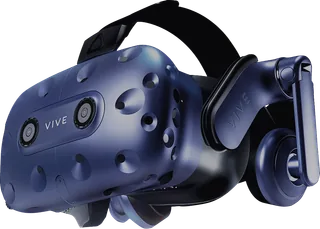
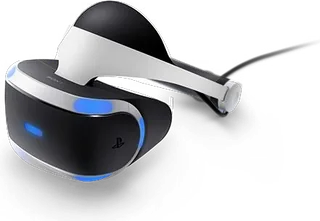
HTC VIVE Pro vs Sony PlayStation VR
Better figure, where one is clearly better
| HTCVIVE Pro | SonyPlayStation VR | |
|---|---|---|
| Overview | ||
| Released | April 2018 | October 2016 |
| Display | ||
| Resolution per eye | 1440 × 1600 (better) | 960 × 1080 |
| Panel | OLED | OLED |
| Refresh rate | 90 Hz | 120 Hz (better) |
| Display details | Dual 3.5-inch AMOLED displays; 1440 × 1600 per eye at 90 Hz. HTC's stated 110° field of view has no specified axis. | Single 5.7-inch OLED RGB panel, 1920 × RGB × 1080 overall; 90 or 120 Hz depending on the application. Some games render at 60 fps and reproject to 120 Hz. |
| Lenses | Fresnel lenses retained from original VIVE (Ars Technica); eye relief adjusts separately | Non-Fresnel lenses (Road to VR); Sony quotes approximately 100° field of view without specifying horizontal or diagonal |
| Lens spacing (IPD) | Physical lens-spacing knob with on-screen distance indication; manufacturer range omitted because not established | Software interpupillary-distance setting and camera-assisted measurement; no physical lens-spacing adjustment (Road to VR) |
| Tracking and input | ||
| Eye tracking | No | No |
| Hand tracking | Yes | No |
| Controllers in the box | No | No |
| Colour passthrough | Yes | No |
| Sensors | SteamVR Tracking 1.0 and 2.0 compatible; external base stations required. VIVE Hand Tracking SDK supports controller-free tracking in compatible apps. Original Pro has no built-in eye tracking; Pro Eye is a separate model. | External PlayStation Camera tracks blue LEDs on the headset; six-axis motion sensor with three-axis gyroscope and accelerometer. No eye tracking or controller-free hand tracking. |
| Controllers | Original headset-only package excludes controllers and base stations; existing VIVE controllers and base stations can be reused. Later Full Kit includes Controller (2018) and SteamVR Base Stations 2.0. | Uses DUALSHOCK 4, PlayStation Move or compatible game-specific controllers; controller requirements depend on the game. Camera and controllers are separate from the original base package. |
| Passthrough | Two front-facing RGB cameras; HTC's SRWorks SDK provides a stereoscopic see-through view and depth sensing. Camera software support was expanded after launch; use requires compatible software and enabling cameras in SteamVR. | No camera passthrough view; the visor slides forwards to see surroundings |
| Performance | ||
| Works | Needs a PC or console | Needs a PC or console |
| Connections | Powered link box connects to PC over DisplayPort 1.2 or newer and USB 3.0; supplied DisplayPort and USB cables. Proprietary headset tether; optional VIVE Wireless Adapter sold separately. | CUH-ZVR1 headset connects through the supplied processor unit to PlayStation 4 by HDMI and USB; the unit also supplies Social Screen output to a TV. Original unit supports 4K YUV 420 TV passthrough up to 60 Hz but not HDR. PlayStation 5 use requires the PlayStation Camera adaptor and compatible controllers. |
| Design | ||
| Battery | None (powered by a PC or console) | None (powered by a PC or console) |
| Weight (headset) | 769 g | 610 g (better) |
| Audio | Removable on-ear headphones with built-in amplifier; integrated microphones. HTC also supplies Audio SDK support for alert and conversation modes. | Built-in microphone and stereo headphone socket on the inline remote; supplied stereo earbuds. Processor unit provides 3D audio processing, rather than extra game-rendering power. |
| Strap | Rigid adjustable headband, rear sizing dial and top strap; 769 g without cable measured by Tom's Hardware. Its complete headset and cable measured 1017 g. | Adjustable headband with rear dial and sliding scope; approximately 187 × 185 × 277 mm excluding projecting parts at the shortest headband length. Headset 610 g excluding cables; processor unit 365 g. |
| In the box | Launch headset-only package has headset and cable, face cushion, cleaning cloth, earphone hole caps, link box, power adaptor, DisplayPort cable, USB 3.0 cable and mounting pad; PC, controllers and base stations separate | Original base package has CUH-ZVR1 headset, processor unit, headset connection cable, HDMI cable, USB cable, stereo headphones with earpieces, AC power cord and AC adaptor; no camera or controllers |
More comparisons
- HTC VIVE Pro vs Valve Steam Frame
- Sony PlayStation VR vs Valve Steam Frame
- HTC VIVE Pro vs Meta Quest 3
- Meta Quest 3 vs Sony PlayStation VR
- Sony PlayStation VR vs Sony PlayStation VR2
- HTC VIVE Pro vs HTC VIVE XR Elite
- HTC VIVE Pro vs Valve Index
- Sony PlayStation VR vs Valve Index
- HTC VIVE Pro vs Meta Oculus Rift S
- HTC VIVE vs HTC VIVE Pro
- HTC VIVE Pro vs Meta Oculus Rift
- HTC VIVE vs Sony PlayStation VR
- Meta Oculus Rift vs Sony PlayStation VR