HTC VIVE vs HTC VIVE Pro
Better figure, where one is clearly better
| HTCVIVE | HTCVIVE Pro | |
|---|---|---|
| Overview | ||
| Released | April 2016 | April 2018 |
| Display | ||
| Resolution per eye | 1080 × 1200 | 1440 × 1600 (better) |
| Panel | OLED | OLED |
| Refresh rate | 90 Hz | 90 Hz |
| Display details | Dual 3.6-inch AMOLED displays; 1080 × 1200 per eye at 90 Hz. HTC's stated 110° field of view has no specified axis. | Dual 3.5-inch AMOLED displays; 1440 × 1600 per eye at 90 Hz. HTC's stated 110° field of view has no specified axis. |
| Lenses | Fresnel lenses (PC Gamer); separate eye-relief adjustment | Fresnel lenses retained from original VIVE (Ars Technica); eye relief adjusts separately |
| Lens spacing (IPD) | Physical lens-spacing knob; 60.2–74.5 mm range reported by Ars Technica | Physical lens-spacing knob with on-screen distance indication; manufacturer range omitted because not established |
| Tracking and input | ||
| Eye tracking | No | No |
| Hand tracking | Yes | Yes |
| Controllers in the box | Yes | No |
| Colour passthrough | Yes | Yes |
| Sensors | SteamVR Lighthouse tracking with two external base stations; seated, standing and room-scale use. Later VIVE Hand Tracking SDK supports controller-free skeleton tracking in compatible apps; its 3D print mode is not supported on original VIVE. No built-in eye tracking. | SteamVR Tracking 1.0 and 2.0 compatible; external base stations required. VIVE Hand Tracking SDK supports controller-free tracking in compatible apps. Original Pro has no built-in eye tracking; Pro Eye is a separate model. |
| Controllers | Two wireless tracked wands with trackpads, grip buttons, dual-stage triggers and haptic feedback; Micro-USB charging. Controller battery life is separate from the PC-powered headset. | Original headset-only package excludes controllers and base stations; existing VIVE controllers and base stations can be reused. Later Full Kit includes Controller (2018) and SteamVR Base Stations 2.0. |
| Passthrough | Single front camera; SteamVR offers boundary outlines or a small full-colour live view (Ars Technica) | Two front-facing RGB cameras; HTC's SRWorks SDK provides a stereoscopic see-through view and depth sensing. Camera software support was expanded after launch; use requires compatible software and enabling cameras in SteamVR. |
| Performance | ||
| Works | Needs a PC or console | Needs a PC or console |
| Connections | PC connection through powered link box; HDMI 1.4 or DisplayPort 1.2 and USB 2.0 or newer. Original tether combines HDMI, USB and power (Ars Technica). | Powered link box connects to PC over DisplayPort 1.2 or newer and USB 3.0; supplied DisplayPort and USB cables. Proprietary headset tether; optional VIVE Wireless Adapter sold separately. |
| Design | ||
| Battery | None (powered by a PC or console) | None (powered by a PC or console) |
| Weight (headset) | 555 g (better) | 769 g |
| Audio | Integrated microphone, 3.5 mm headphone connection and separate earbuds; original headset has no integrated headphones. Deluxe Audio Strap is a separate later accessory. | Removable on-ear headphones with built-in amplifier; integrated microphones. HTC also supplies Audio SDK support for alert and conversation modes. |
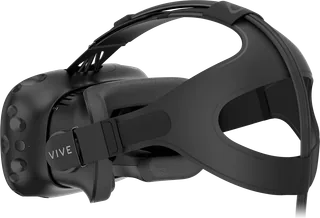
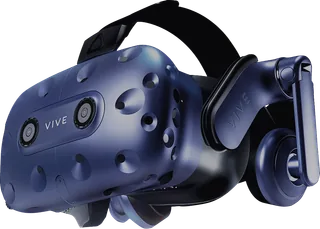
| Strap | Adjustable fabric straps; original launch headset is 555 g without cables according to Ars Technica. Later hardware revisions may differ. | Rigid adjustable headband, rear sizing dial and top strap; 769 g without cable measured by Tom's Hardware. Its complete headset and cable measured 1017 g. |
| In the box | Headset, two controllers, two base stations, link box, tether, earbuds, cables, chargers and mounting accessories; gaming PC separate | Launch headset-only package has headset and cable, face cushion, cleaning cloth, earphone hole caps, link box, power adaptor, DisplayPort cable, USB 3.0 cable and mounting pad; PC, controllers and base stations separate |
More comparisons
- HTC VIVE vs Valve Steam Frame
- HTC VIVE Pro vs Valve Steam Frame
- HTC VIVE vs Meta Quest 3
- HTC VIVE Pro vs Meta Quest 3
- HTC VIVE Pro vs HTC VIVE XR Elite
- HTC VIVE vs HTC VIVE XR Elite
- HTC VIVE vs Valve Index
- HTC VIVE Pro vs Valve Index
- HTC VIVE Pro vs Meta Oculus Rift S
- HTC VIVE vs Meta Oculus Rift S
- HTC VIVE Pro vs Sony PlayStation VR
- HTC VIVE Pro vs Meta Oculus Rift
- HTC VIVE vs Sony PlayStation VR
- HTC VIVE vs Meta Oculus Rift