HTC VIVE vs Valve Steam Frame
Better figure, where one is clearly better
| HTCVIVE | ValveSteam Frame | |
|---|---|---|
| Overview | ||
| Released | April 2016 | September 2026 |
| Display | ||
| Resolution per eye | 1080 × 1200 | 2160 × 2160 (better) |
| Panel | OLED | LCD |
| Refresh rate | 90 Hz | 144 Hz (better) |
| Field of view | – | 110° horizontal |
| Display details | Dual 3.6-inch AMOLED displays; 1080 × 1200 per eye at 90 Hz. HTC's stated 110° field of view has no specified axis. | Two 2160 × 2160 LCD panels, one per eye; 72, 80, 90, 120 and 144 Hz (144 Hz experimental) |
| Lenses | Fresnel lenses (PC Gamer); separate eye-relief adjustment | Custom pancake lenses with glass and non-glass elements; field of view up to 110° (Valve gives 110° horizontal and vertical to UploadVR); eyeglasses up to 140 mm wide |
| Lens spacing (IPD) | Physical lens-spacing knob; 60.2–74.5 mm range reported by Ars Technica | 60–70 mm target range, adjusted with a wheel on top of the headset |
| Tracking and input | ||
| Eye tracking | No | Yes |
| Hand tracking | Yes | No |
| Controllers in the box | Yes | Yes |
| Colour passthrough | Yes | No |
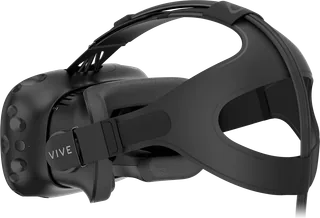
| Sensors | SteamVR Lighthouse tracking with two external base stations; seated, standing and room-scale use. Later VIVE Hand Tracking SDK supports controller-free skeleton tracking in compatible apps; its 3D print mode is not supported on original VIVE. No built-in eye tracking. | Inside-out; 4 outward-facing monochrome cameras for headset and controller tracking with IR illuminators for low light; 2 interior cameras for eye tracking and foveated streaming; no controller-free hand tracking (UploadVR) |
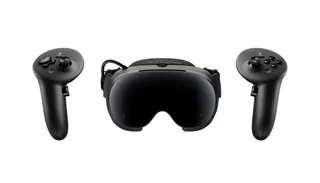
| Controllers | Two wireless tracked wands with trackpads, grip buttons, dual-stage triggers and haptic feedback; Micro-USB charging. Controller battery life is separate from the PC-powered headset. | Steam Frame Controllers with 6-DoF tracking, ABXY buttons (right), D-pad (left), full-size magnetic TMR thumbsticks with capacitive touch, analogue triggers, bumpers, dual-stage grip buttons, capacitive finger tracking and a haptic motor; one AA battery each, about 40 hours; 130 g each with battery |
| Passthrough | Single front camera; SteamVR offers boundary outlines or a small full-colour live view (Ars Technica) | Monochrome passthrough from the outward-facing cameras; front expansion port (dual MIPI camera interface or PCIe Gen 4 x1) takes accessories such as the Arcturus Vision colour camera |
| Performance | ||
| Works | Needs a PC or console | Standalone or with a PC |
| Chip | – | Snapdragon 8 Gen 3 |
| Storage | – | 256 GB, 1 TB |
| Chip details | – | 4 nm Snapdragon 8 Gen 3, ARM64; runs SteamOS 3 (Arch-based) with KDE Plasma desktop |
| Memory | – | 16 GB unified LPDDR5X; 256 GB or 1 TB UFS storage; microSD card slot |
| Connections | PC connection through powered link box; HDMI 1.4 or DisplayPort 1.2 and USB 2.0 or newer. Original tether combines HDMI, USB and power (Ars Technica). | Streams from a PC, Steam Deck or Steam Machine over Wi-Fi; headset has Wi-Fi 7 2 × 2 with dual radios (5 GHz Wi-Fi and 6 GHz VR streaming at once); Wi-Fi 6E (6 GHz) USB wireless adapter included; Bluetooth 5.4; no DisplayPort cable connection |
| Design | ||
| Battery | None (powered by a PC or console) | Built in |
| Weight (headset) | 555 g | 440 g (better) |
| Battery details | – | 21.6 Wh Li-ion battery at the back of the headstrap; charges over USB-C 2.0 at up to 45 W (15 V, 3 A); Valve doesn't give a battery life |
| Audio | Integrated microphone, 3.5 mm headphone connection and separate earbuds; original headset has no integrated headphones. Deluxe Audio Strap is a separate later accessory. | Dual speaker drivers per ear built into the headstrap; dual microphone array |
| Strap | Adjustable fabric straps; original launch headset is 555 g without cables according to Ars Technica. Later hardware revisions may differ. | Modular headstrap (245 g) holding the speakers and battery; the 185 g core module detaches for other straps; core module and facial interface 175 × 95 × 110 mm |
| In the box | Headset, two controllers, two base stations, link box, tether, earbuds, cables, chargers and mounting accessories; gaming PC separate | Headset, two Steam Frame Controllers, Wi-Fi 6E wireless adapter, standard light blocker, face gasket and head cushion; Half-Life: Alyx licence. No power supply; Valve sells a 45 W one separately |
More comparisons
- Meta VR Glasses vs Valve Steam Frame
- HTC VIVE Pro vs Valve Steam Frame
- Meta Oculus Rift vs Valve Steam Frame
- Meta Oculus Rift S vs Valve Steam Frame
- Meta Quest 3 vs Valve Steam Frame
- Samsung Galaxy XR vs Valve Steam Frame
- Valve Index vs Valve Steam Frame
- Meta Quest 2 vs Valve Steam Frame
- Meta Quest 3S vs Valve Steam Frame
- Meta Oculus Quest vs Valve Steam Frame
- Sony PlayStation VR vs Valve Steam Frame
- HTC VIVE vs Meta Quest 3
- HTC VIVE vs HTC VIVE XR Elite
- HTC VIVE vs Valve Index
- HTC VIVE vs Meta Oculus Rift S
- HTC VIVE vs HTC VIVE Pro